
Are you travelling to the Balkans? Want to know the best things to do in Skopje? If you love “quirkiness” as much as we do, you will definitely appreciate Skopje.
Skopje is the capital of North Macedonia and it’s one of the most unusual cities we’ve ever visited. The city centre was almost flattened by an earthquake in 1963. And then the centre was rebuilt with grand baroque buildings as part of Project 2014. This was an attempt to make the city look more “European”.
We visited the country’s capital in October 2025 as part of our European road trip in our campervan. We spent 2 days exploring the grand squares, parks and narrow alleyways of this intriguing city. In this post you’ll find our favourite things to see in Skopje.
Disclaimer: This post may contain affiliate links. If you purchase through these links, we may earn a small commission, at no extra cost to you. Purchasing through these links supports our work and allows us to continue bringing you travel guides, like this, for free. As an Amazon Associate, we earn a commission from qualifying sales. Thank you for your support.

Best things to do in Skopje
1. FREE Guided Walking Tour of Skopje
If you’ve just arrived and you’re wondering what to do in Skopje, a guided walking tour is a great start. We love doing a walking tour when we first arrive in a city. It not only gives us a great introduction to the history and culture of a place, but also a local’s perspective.
We started our exploration of the city with a 3 hour free walking tour that we booked through Guru Walks. Our guide Dean was brilliant – informative and entertaining! These “free” walking tours are tip based, so at the end of the tour, you simply pay the guide what you feel appropriate. Most people pay between €10-20.

2. Macedonia Square
The heart of the city is Macedonia Square. Here you’ll find some of the city’s grandest (and most controversial) monuments and buildings.
Project 2014 was actually launched a few years earlier, and targetted for completion in 2014. Many of the buildings and statues in the square (and over the river) were part of this government-led urban renewal program.

3. Warrior on Horseback statue (aka Alexander the Great statue)
Possibly the most controversial monument is this huge statue, taking pride of place in the centre of Macedonia Square. The statue is widely accepted to be modelled on Alexander the Great. However, to appease the Greeks the statue is officially called Warrior on Horseback.
The statue was unveiled in 2011 as part of Project 2014. It consists of 14.5m statue of Alexander (oops, a warrior on horseback) atop a 10m pillar. There are carvings of warriors around the base of the pillar.

4. Porta Macedonia (Triumphal Arch)
Not quite as tall as the “Warrior on Horseback” the Porta Macedonia is Skopje’s answer to Paris’ Arc de Triomphe. This monument, also part of Project 2014, was unveiled in January 2012. It was built to commemorate North Macedonia’s 20th anniversary of independence.
Apparently you can take a lift to a viewing deck at the top, however this wasn’t opened when we visited. Perhaps because the Skopje Marathon was being held, and the finish line was just after runners past under the Arch.

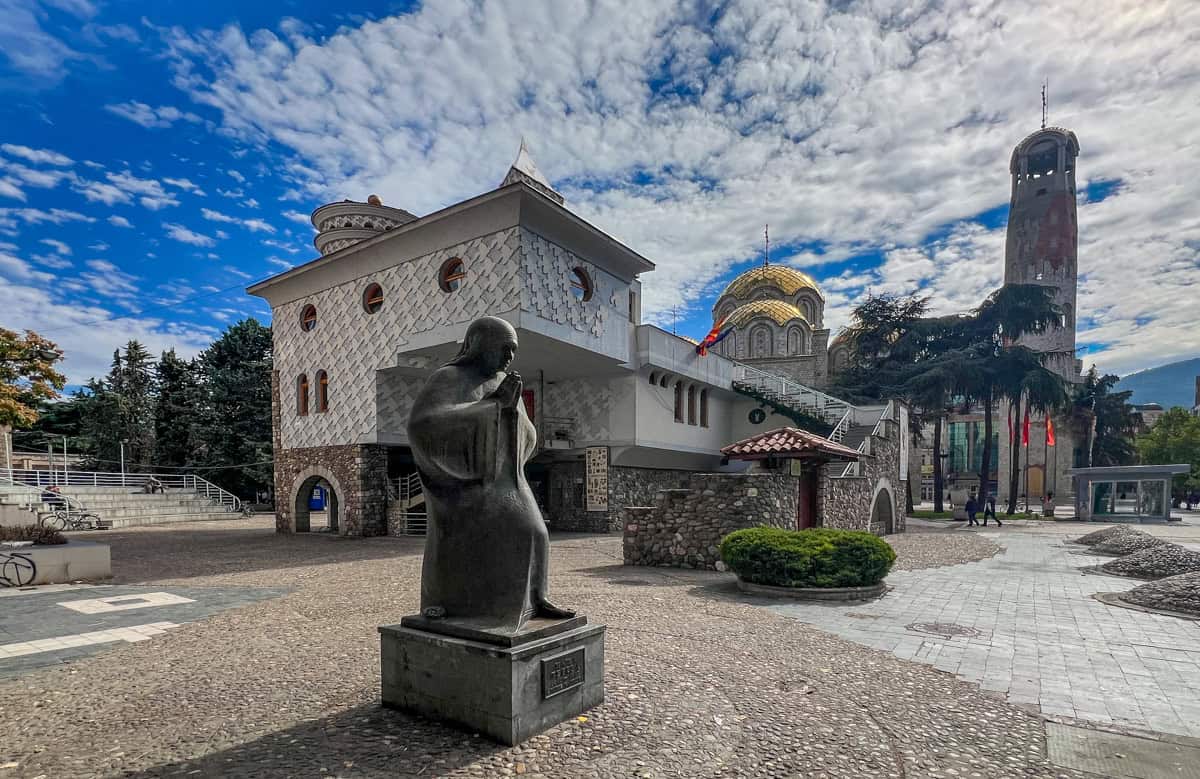
5. Mother Theresa Memorial House
Saint Mother Theresa was born in Skopje in 1910. There is a small plaque where her birth house was located, though this house was destroyed in the 1963 earthquake. She felt the calling as a young girl, and left Skopje at age 18 to join a nunnery.
She returned to Skopje only 4 times in her lifetime. The first time was after the earthquake. At that time she recalled a catholic church where she used to pray. In 2008 the Mother Theresa Memorial House was built on the site of this church.
The house contains a small but beautifully curated museum, full of old photos of Mother Theresa starting from her childhood and showing her life as a nun, and with various famous people like the Dalai Lama. There is also a small chapel upstairs where Mass is held weekly.
The Mother Theresa Memorial house is open Monday to Friday 9am to 8pm, and weekends 9am to 2pm. The house is free to enter.
6. Church of Saints Constantine and Helena
Right next to the Mother Theresa Memorial house is the brand new Church of Saints Constantine and Helena. This church was built from 2008 and opened in September 2025. When we visited in early October, it was obvious the building hadn’t quite been finished, but the church is impressive both inside and out.
The outside is built of travertine with gold painted domes, and inside is full of beautiful frescoes, icons and mosaics.
The church is open 6 to 8pm Monday to Friday, 6 to 5pm Saturday, 6am to midnight Sunday and is free to enter.

7. Museum of the City of Skopje
In 1963 Skopje was almost flattened by an earthquake, with around 90% of the city’s buildings damaged. One wing of the main railway station collapsed, but the central section remained standing. The clock on the wall stopped at 5:17am, the time the earthquake struck.
The right wing of the old railway station now houses the City Museum of Skopje. The museum tells the story of the city of Skopje, from Roman times right up to today, with a special section on the 1963 earthquake.
The museum is open 9am to 5pm Tuesday to Saturday, 9am to 1pm Sunday and closed Monday. Entry to the museum is free.

8. Old Stone Bridge
Take a walk across the 15th century Ottoman Stone Bridge, which links old and new Skopje. This bridge was built on the site of a much earlier bridge, dating back to Roman Emperor Justinian. You can see a statue of Justinian on the south-western side of the bridge.
The Old Bridge has become a focal point for street entertainers, adding a cool vibe to the place. We enjoyed watching an old guy playing saxophone and young Roma kids playing drums (or even tin cans)
The bridge has been damaged repeatedly by floods and earthquakes and repaired many times. It is viewed today as a powerful symbol of Skopje’s resilience and unity, appearing even on the city’s coat of arms.

9. Skopje Old Bazaar (Čaršija)
Skopje’s Ottoman-era market is supposedly the largest Old Bazaar in the Balkans. It’s narrow streets host handicrafts (and souvenir) stores, gold shops and cafés. You’ll also find a few mosques and an old hammam (Turkish Bath-house) here.
We love wandering around and getting lost in these old bazaars. Time it right and you’ll hear the call to prayer as you stroll. We loved the choruses reverberating off the old stone walls.
Don’t miss the area around the Kapan An, an old caravanserai. The area out front features a HUGE tree, shading cafes, bars and restaurants. A perfect buzzing place for a coffee, lunch or dinner where you can sample traditional food.
We ate at two restaurants here, and although they are touristy (heck, one was even named Turist!), the food was great and the prices very reasonable.

10. Mustafa Pasha Mosque
The Mustafa Pasha Mosque is the oldest mosque in Skopje. It was built in 1492, and stands as one of Skopje’s finest surviving Ottoman monuments. Interestingly, it sustained almost no damage in the 1963 earthquake.
The mosque features a graceful minaret and a single domed roof. There is a large courtyard and garden out front, making it a peaceful respite from the busy bazaar.
The mosque remains in use today but welcomes non-Muslim visitors outside of prayer times. Entry is free, although donations are welcomed. Don’t forget you’ll need to remove your shoes before entering, and you’ll need to be suitably dressed (shoulders and legs covered, and women should cover your head).
We did visit the inside although we find that many mosques can be appreciated more so from the outside as from inside.

11. Kale Fortress
The Kale Fortress (Skopje Castle) dates back from the 6th century, though it may have been built on even earlier foundations. The fortress was added to by the Ottomans and the walls are really all that stand today.
You can walk along the walls to see sweeping views over the city and the river valley and out to the mountains.
The fortress is free to enter, although there is a security guard on duty. The guard we encountered at the gate (Ismail) insisted we crack open a walnut with a stone. If we squashed the walnut, he wouldn’t let us in! It was a fun encounter that almost felt like a “rite of passage” to be granted access to the grounds.
If you can, try to be at the fortress during sunset, for the best photography.

12. Museum of Macedonia
The Museum of Macedonia offers a rich overview of the region’s cultural, ethnological, and historical heritage. Inside the museum you’ll find traditional Macedonian costumes, ritual objects, regional tools and displays that trace the area’s diverse roots.
The museum is open Tuesday to Friday from 08:00 to 16:00, Saturday 09:00 to 15:00 and Sunday 09:00 to 13:00. Entry costs 200 Denar.
13. Kurshumli an (Caravanserai)
This abandoned caravanserai is just behind the Museum of Macedonia. It’s a beautiful example of Ottoman architecture. A caravanserai was an inn, where travellers could stay free for 3 nights. Caravanserais were dotted along the trading route between Turkey and the Adriatic. This stop in Skopje was of major importance.
The Caravanserai was closed when we visited, however, we could admire the building from the outside, and peep through the cracks in the door at the courtyard.

14. Church of the Ascension of Christ
The Church of the Ascension of Christ is an eastern orthodox church that was built in the mid-16th century under Ottoman rule. The church was partly built below ground level which was a subtle concession to the restriction of Christian buildings under Ottoman law.
Inside the church is a beautiful iconostasis that was crafted in the 19th century by local guilds and merchants. Sadly, photography and videography is not allowed inside the church. Entry to the church is 120 Denar.
The courtyard leading to the tiny church is delightful, with manicured gardens and pomegranate trees. Goce Delčev (1872-1903) a Macedonian national hero who fought for independence from the Ottomans is buried here in a white marble sarcophagus.
While photography isn’t allowed inside, there’s a great photo opportunity with the flag in the courtyard. Entry to the courtyard is free.

15. Discover Skopje’s Statues
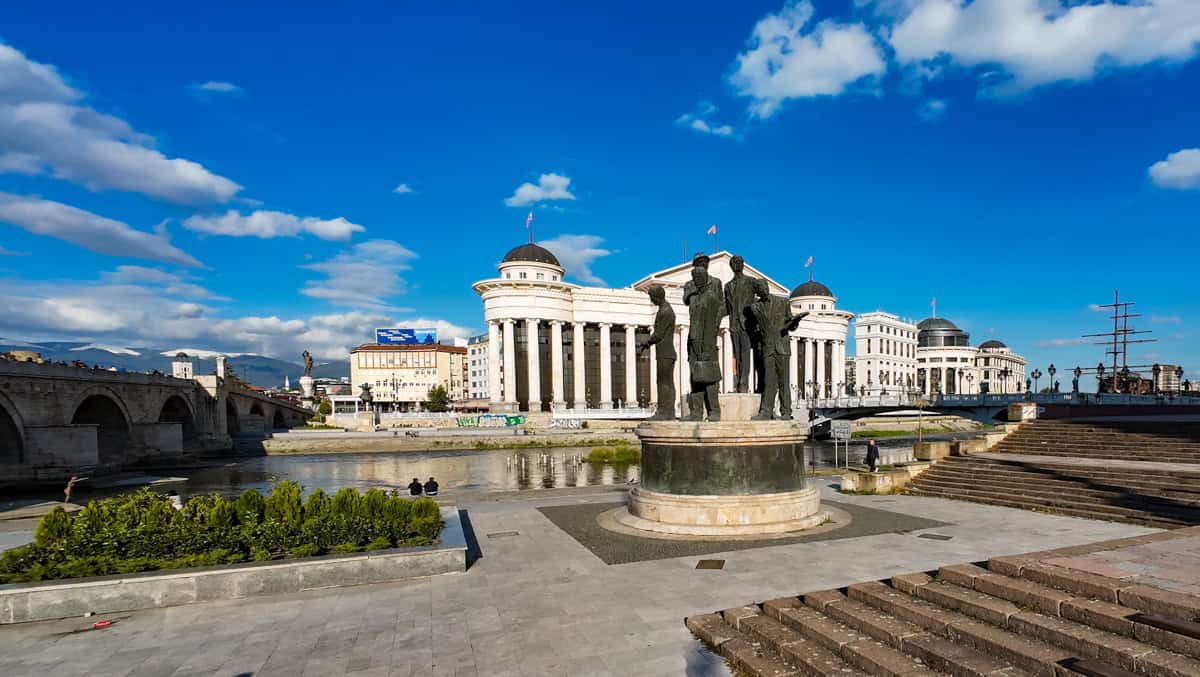
Across the river from Macedonia Square, you’ll see a fountain representing the Mother’s of Macedonia, and another statue of a Warrior. Well, that’s their official names. They are widely understood to represent Alexander the Great’s mother Olympia, and his father Phillip, but again, the disagreements with Greece!
All throughout the city there are many statues, over 130 according to some accounts. Some of these are obvious (Mother Theresa outside her Memorial House) others are very socialist (see those in the Woman Warrior Park) and others are just weird (see the Shoe Shine Man, or “Homeless”, just off Macedonia Square).
Some people like to make a point of going around finding these statues, but we preferred to just stumble across them and be surprised.

16. Archaeological Museum of Macedonia
The Archaeological Museum contains over 7,000 artefacts, dating back to pre-history and through the mediaeval period. In 2015 this museum was rated in the top ten museums in Europe!
The collection has been housed in several different buildings (including the Kurshumli An just after the 1963 earthquake). In 2014 this new building was opened.
Even if you don’t go into the museum (we didn’t) it’s worth crossing the Bridge of Civilizations, which has statues of important leaders from history, who have influenced the region over the centuries.

16. Millennium Cross – Cable Car to Mount Vodno
The Millennium Cross is a large steel cross, standing 66m tall on the peak of Mt Vodno which overlooks the city of Skopje. The cross was unveiled in 2002 to commemorate 2000 years of Christianity in Macedonia.
To get to the Millennium Cross, take bus #25 from the centre to Middle Vodno and then the cable car. The cable car runs Tuesday to Sunday from 10am to 8pm during summer (May to September) and 10am to 5pm in winter. A return ticket costs 100 Denar and the journey takes 4 minutes.
If you don’t have time to go to the Millennium Cross, there is a similar cross in the east of the city in the suburb of Dravčevo. This cross is only slightly smaller (63.5m high) and you’ll likely drive past it as you’re coming into town (especially if you’re coming from the east, from the airport, or Sofia Bulgaria as we were).
Best Day Trip from Skopje
Matka Canyon
Matka Canyon is only 40 mins drive from the city centre. You’ll find some beautiful scenery and a moderately easy hike here. If you choose to hike to the end of the trail it is 10kms return on flat terrain.
If you don’t feel like hiking, you can take a boat cruise on the Matka Canyon. Prices for the motor boat cruises start at 300 Denar (€5 per person) for a 20 min round trip, and up to €20 which takes you to the cave much further up stream.
We would strongly advise against visiting the canyon during the weekend. Atanas from the camper stop and our walking tour guide Dean both warned us how busy the canyon can be on weekends. Its a popular day trip for locals from Skopje.
The final road out to the canyon is quite narrow, and people park along both sides of the road. We’d read horror stories of people being stuck down there waiting for parked cars to move!
There are several very affordable day trips from Skopje to Matka Canyon. This one gets great ratings, and includes a boat trip on the canyon and a visit to the Millenium Cross.
Van Life Tip: We parked up alongside the river for 2 nights. There is a flat area on the hard shoulder a few hundred metres downstream of where the tour buses park. We found it to be quiet at night and nobody bothered us. Both nights we were there we were joined by a couple of other campervans.

Skopje Travel Guide – Essential Information
How to get to Skopje, North Macedonia
Skopje is located in the north of North Macedonia, a land-locked country in the Balkans. The city has a population of around 600,000 and the city centre is quite compact.
By Air
Skopje International airport is approximately 22km from the city centre. Flights arrive from most European capitals with connecting flights around the world. Check flight availability and pricing on Skyscanner.
To get from Skopje Airport to the city, you can take a shuttle bus which costs 199 Denar and takes 20-30 minutes, depending on traffic. For more information and the shuttle bus timetable check the transport company’s website.
A taxi from the airport will cost you 1500 Denar or €25. The price is regulated by the Airport and the price list is displayed just outside the terminal.
By Car
The main highways in Macedonia are pretty good. Skopje is well connected to other main centres via a network of motorways. Tolls are collected on some of these and are payable by cash. You can pay in either Denar or Euro.
By Train/Bus
There is a limited public train service operating in North Macedonia. Our research suggests that International train services remain suspended until further notice.
While domestic trains exist, the network is limited in frequency and covers only the lines to Bitola and Kocani, along single track lines. Apparently the government is working on upgrading the railways.
National and local buses arrive and depart in Skopje frequently, and bus travel in the Balkans is quite affordable. For timetables and tickets, check Omio.
Getting Around Skopje
While the city centre is very walkable, we were staying a little way out of town. We caught taxis a couple of times, which only cost us around €5. There is a great app in North Macedonia for booking taxis which will give you an estimate of the price. The app is called Global Taxis. Uber doesn’t operate in North Macedonia.
We also caught the public bus back to the campsite. A single bus ticket costs 50 denars (about €0.80) and you can pay cash to the driver. There is also the SkopjeBus app, where you can buy your tickets online or check timetables.

Where to stay in Skopje
We stayed in our campervan at Campera which is a brand new Campervan Stopover just 4km from the city centre. The stopover is in the large parking lot of an office building, run by Atanas and his family.
The camper stop has everything you need, including possibly the cleanest toilets we’ve ever come across! I swear every time I went there, the lady was cleaning! Atanas should have showers available for next summer. He has them on site, but currently his passion for brewing beer is taking precedence. We did get to sample his Pale Ale though, so we’ve forgiven him!
Parking at Campera is €12 per night plus €3 for electricity. There are several supermarkets within walking distance.
If you’re travelling independently, you’ll find a good variety of accommodation in Skopje, from large hotels to small family run guesthouses. Check booking.com for availability and rates.

Where to eat in Skopje
Admittedly it’s a touristy location, but due to the buzzing vibe, we think it’s worth going taking in a bite to eat in the heart of the old bazaar. We ate at a couple of the restaurants in the courtyard that fronts on to the “Kapan An”.
We enjoyed several traditional dishes and our favourite was tavče gravče (beans baked in a terracotta dish). We also loved the Ajvar, which is a spread made with red peppers.
As with the Balkans in general, Macedonians love their coffee and we found the quality to be very good. We took a seat outside at a Cafe along Macedonia St and paid 360 MRK Denar (€6) for two coffees.
To our surprise, Skopje also has a growing craft beer district. Look out for the Bak Beer, which is brewed in the lovely town of Bitola. We also had a beer at the Old Town Brewery, but to be honest we didn’t enjoy their Pale Ale so much. They do have a good selection of beers, maybe the others are better?
If you’re looking for something a bit more up market, head for the Debar Maalo district. It’s a reasonable walk from the centre of town, so you might like to take a taxi. The area is buzzing with bars, live music (buskers) and quality restaurants. We enjoyed an evening meal at the Barik.

FAQs
Is Skopje worth visiting?
We were so surprised with Skopje! Nigel had visited the city back in the early 1990s but didn’t really remember it. There have been a lot of changes over the last few decades, independence from the former Yugoslavia, and a big rebuilding project. There’s certainly a lot to see and do in Skopje.
We loved the quirky nature of the city, the lively old bazaar, and of course, the friendly, welcoming nature of the local people.
When is the best time to visit Skopje?
The best time of year to visit Skopje is spring or autumn. As with most of the Balkans, the weather will be mild, and there will be fewer crowds.
Having said that, we visited in the first week of October, and there was an unseasonable cold snap! We saw snow on the hill-sides and one day only got to 8 degrees Celsius (about 45 farenheit).

How many days do you need in Skopje?
We thought one day would be enough to see Skopje, but we loved it so much we came back into the city for a second day. We really wanted to just slow down and wander the streets, spend time on the stone bridge with the buskers, and soak in the atmosphere.
So, we would recommend spending two nights here at least. If you have two full days here, you could do a half day trip to Matka Canyon on one day.
Is Skopje affordable?
Yes! Skopje, like most of the Balkans is an affordable option for travellers. We found public transport and taxis to be reasonably priced (along with an app for booking taxis to save us from being scammed).
We ate lunch in a restaurant in the old bazaar for around 800 denar (about €13) for the two of us. Dinner in an upmarket restaurant in Debar Maalo was 2000 denar (about €32).
Is Skopje safe for tourists?
We felt very safe in Skopje both walking around during the day and waiting for a taxi in the evening. The people are warm and friendly.
Of course, be aware of pick-pockets, especially in busy areas like the Old Bazaar.
Watch our Skopje Travel Film
We produce weekly travel vlogs of our European Road Trip for our YouTube Channel. You can enjoy some visual inspiration of Skopje, or check out our full Balkans by campervan playlist.
Where to next?
Continue your Balkans Road Trip by exploring beautiful Lake Ohrid, or by heading north to explore Kosovo.

Found this guide helpful? Please Contact Us if you have any questions about what to see in Skopje.
Why not Buy us a Coffee to say thanks.